
A leader’s challenge has been the same for quite a while: Assemble a diverse team with the right mix of talent to accomplish big goals. Here’s the problem: the tools to accomplish this task have been a little clunky. Some aren’t inherently business focused. Others are complex and require a lot of time, money, and energy to use effectively. A new tool is called “The 6 Types of Working Genius,” or just “Working Genius” for short developed by Patrick Lencioni helps solve some of these challenges.
Different Genius Types
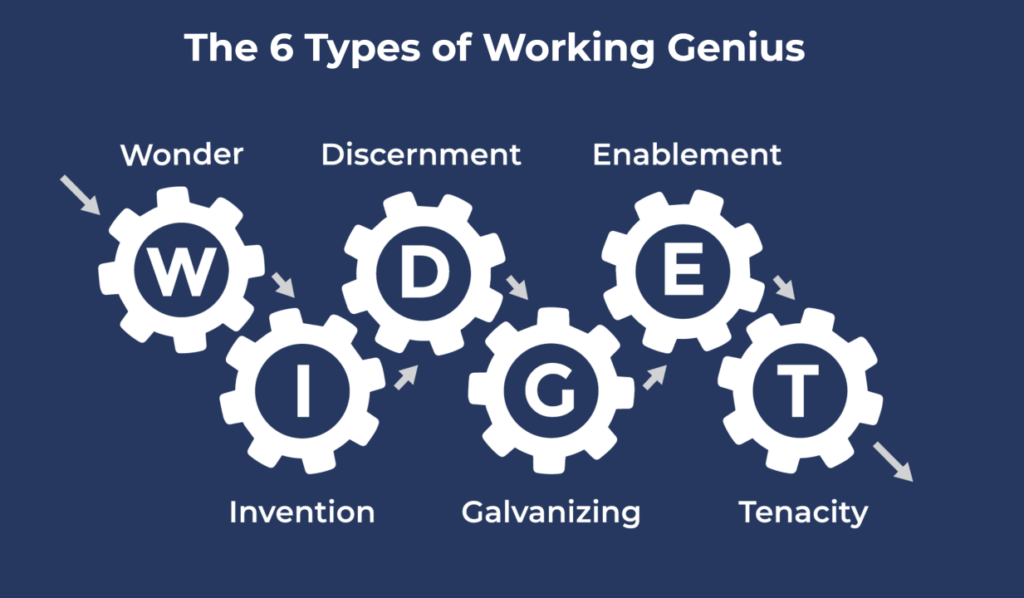
Based on this model, for every project there are six areas required for accomplishing them:
- Wonder: This is where it all starts, with a simple ‘What if?’ or ‘Why not?’ It’s about noticing something that’s not quite right or could be better, sparking the desire to make a change. It identifies the need for improvement or change.
- Invention: Next comes that ‘Aha!’ moment. It’s when you come up with a bright idea or solution that seems to answer the call for change you felt earlier. It confirms the importance of that need and generated an idea or solution in the first place.
- Discernment: Here’s where you put on your critical thinking hat. You take a good, hard look at your idea. It assesses the merit and workability of the idea or solution. Is it practical? Will it really work? This stage is all about evaluating and refining.
- Galvanizing: Now, you’re excited and you want everyone else to be, too. You share your idea, spread the enthusiasm, and get others on board. It’s all about building momentum. This stage generates enthusiasm and action around the idea or solution.
- Enablement: This is where things start happening. You gather resources, make plans, and begin to bring your idea to life. It’s about turning talk into action and initiates support and assists in the implementation of the idea or solution.
- Tenacity: Finally, it’s about sticking with it. Every project has its ups and downs, but what matters is pushing through, making adjustments as needed, and seeing things through to the end.” This stage commits to ensuring that the idea or solution gets completed and that desired results are achieved.
All Six Types Are Essential to a Team.
I found this way of thinking about the different parts of work to be so helpful, as we talk about the Working Genius model, we clearly identify what genius is missing from our teams and we understand why it is important for us to add a person or people with this genius to our team.
How does the Working Genius model differ from spiritual gifts inventories or strengths assessments? Like these, the Working Genius model helps us understand and appreciate our differing abilities. But it goes beyond that. It shows us why any team or project needs all six different geniuses to get work done.
Each Genius is Needed at a Certain Time.
Furthermore, there is a logical sequence when each working genius needs to “show up” in the natural progression of getting work done.
The first two geniuses (Wonder and Invention) are in the ideation phase of work. Then in the activation stage, the Discernment and Galvanizing geniuses are most needed. They take the ideas generated in the first phase, refine them, and inspire the team to adopt and rally around the new idea. Finally, in the implementation phase, Enablement and Tenacity shine. In this stage, the idea becomes reality, and the team needs their geniuses to work together to complete the project.
Generally, in most workplaces, we will need more people with Enablement and Tenacity than we need people with Wonder and Invention. But each genius is needed for the overall project. Each needs to come to the fore at a particular stage of the work. While the Wonder and Invention geniuses are most prominent in the early stages, they need to take more of a back seat in the later stages. It is not helpful to keep suggesting new ideas when the implementation is already well underway.
The Geniuses in Practice
I’ve spent many years helping facilitate and lead teams. These “genius” concepts can help all teams be more productive and have a higher level of satisfaction.
You start with the curious minds, the ones who always ask “why.” They’re the dreamers, the ones who see what could be and Wonder why it isn’t. They’re essential because they challenge the status quo and see potential everywhere.
Then there are the problem solvers, the ones who Invent out “how” to make things happen. They’re the ones who can take an abstract idea and turn it into a concrete plan. They’re like the engineers of the team, turning dreams into realities.
Also while everyone can tap into these geniuses, some are naturally better at certain ones. Everyone brings something unique to the table.
The Discerners play a crucial role too. They’re like the quality controllers, providing essential feedback and helping to refine ideas. They have an eye for detail and can spot what’s working and what’s not.
And of course, you can’t forget the Galvanizers. They’re the charismatic ones who get everyone excited about an idea. They’re the motivators, the ones who can rally the troops and get everyone moving in the same direction.
Then there are the Enablers, the unsung heroes who work behind the scenes to support and help others. They’re the glue that holds the team together, always there to lend a hand and make sure things are running smoothly.
Finally, the Tenacious finishers. They’re the ones with the drive and determination to see things through to the end. They keep the momentum going and ensure that the project crosses the finish line.
It’s a brilliant way of looking at team dynamics, almost like assembling a superhero team where each member plays a crucial role in achieving success. It’s not just about having a good idea; it’s about having the right mix of people to bring that idea to life.
The Working Genius and Teams
The Working Genius model is such a game-changer for team dynamics. Think of it like having a sports team where every player knows their position and plays to their strengths. As a manager, you’re like the coach who gets to strategize the best plays by understanding each team member’s unique talents.
Imagine you’ve got someone who’s great at brainstorming ideas – that’s their zone! You’d want them front and center during the creative phase, right? But then, there’s someone else who’s amazing at execution, so you bring them in when it’s time to get things rolling.
What’s fantastic about this model is how it helps everyone feel valued and understood. It’s all about playing to your strengths and supporting each other where it’s needed.
This approach can totally transform the culture of a team. It’s like switching from a ‘one-size-fits-all’ to a ‘tailor-made’ strategy. It can lead to people feeling more motivated, less stressed, and just overall happier at work. Plus, it’s great for productivity – like a well-oiled machine where every part does exactly what it’s best at.
What are your areas of genius?
#leadership #leadershipdevelopment #transformationalleadership
Business doesn’t have to be complicated. It’s about what they want to achieve. We are all about transforming businesses through strategic operations, process improvement and technology implementation. When you are ready to streamline your operations and save on time, energy, and money, give us a shout. Lets set a free strategy call to see if we can help you https://cal.com/stratusbusiness/free-strategy
When the outcome matters, think of us as your secret weapon – we’ll tell the story of your business transformation together!